
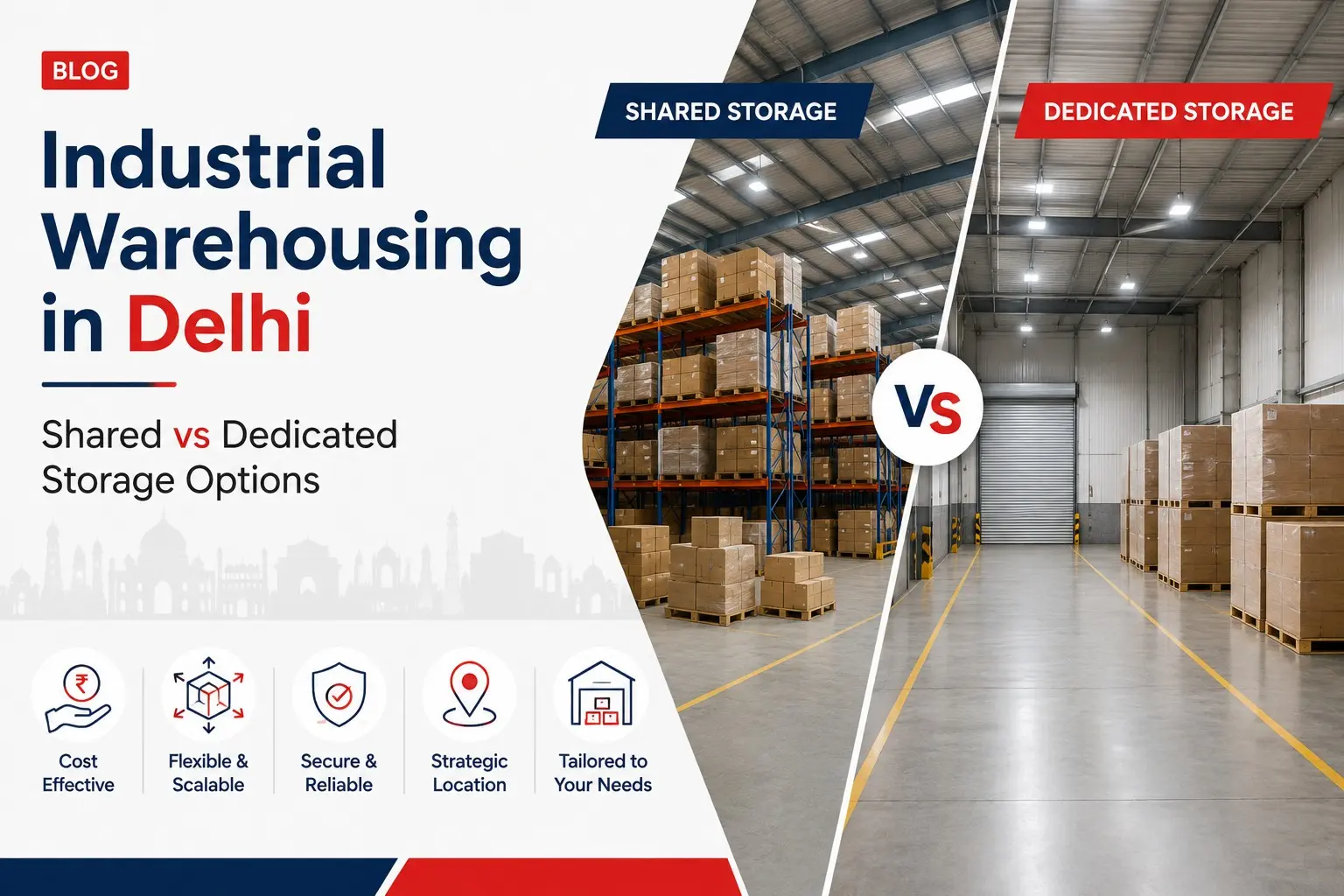
Industrial Warehousing in Delhi: Shared vs Dedicated Storage Options
Delhi serves as a hub of India's supply chain network. From traditional manufacturing hubs in Okhla to modern logistics parks along Kundli, Sonipat, and Greater Noida, the demand for industrial warehousing in Delhi NCR has increasing day by day. It helps businesses expand their operations and strengthens the supply chain.
But one question that businesses ask is whether they should get shared or dedicated storage space in Delhi. It depends on their type of goods, duration, inventory management, and budget. Making the wrong choice can result in inflated operational costs, underutilized space, or severe logistical bottlenecks. In this blog, we compare the advantages and disadvantages of shared and dedicated storage options, along with differences, so you can make the right decision for your business.
What Is Shared Warehousing?
Shared warehousing is the storage type in which various businesses use the same premises. Rather than hiring an entire warehouse, you only pay for the unit that you are using. The various operational expenses are divided among the tenants. As a result, it becomes easier to afford staffing, security, and utilities. The space available in a shared warehouse is flexible since you can rent out units whenever you need them without having to commit to the whole building.
Advantages of Using a Shared Warehouse
Some of the main benefits of shared warehousing include:
- Less costs – You only need to pay for the space and the services that you actually use. For smaller businesses or those with limited cash flow, shared warehouses provide a cost-effective means of obtaining the warehouse areas they require.
- Built-in Services – The services built into the system include inventory management, shipping, receiving, and the availability of on-demand labour. You will receive dedicated support even though you don't have to set up and manage these services yourself.
- Scalability – Shared warehouse space provides you with greater flexibility. If you need more storage during the busy seasons or are considering downsizing, you can increase or decrease your shared warehouse space without being obliged to enter into long-term commitment contracts.
- Quicker setup – As the shared warehouses are already in operation, you can start working more quickly. The necessary logistics infrastructure is already in place so that you can begin making a profit.
- Improved networking opportunities – By sharing your warehouse with other businesses, you gain access to new networking possibilities. You can work together with other companies that are using the same warehouse and thus establish important links within the industry. Using a shared warehouse allows you to build a community and help your small business gain an advantage.
Drawbacks of Using a Shared Warehouse
While shared warehouses lower costs and service logistics demands, they have some drawbacks, as follows:
- Limited control – Because it provides you with shared space with other businesses, it doesn't allow you to customize it. The warehouse has to function as efficiently as possible for most of the companies rather than meeting their individual requirements.
- Regarding costs – Although shared warehousing is cost-effective, the rates may vary according to demand, service fees, and peak seasons. Since dedicated warehousing involves longer contracts, its rates are usually more stable.
- Shared space – When you share space with other companies, you will sometimes have to cope with disruptions, and your business could encounter conflicts regarding shipping schedules, warehouse traffic, or the resources available.
What Is Dedicated Warehousing?
A dedicated warehousing arrangement involves setting aside the whole facility, including its space, staff, equipment, and procedures, solely for a single client. The facility can be leased directly by your company or, more typically in India, be run by a third-party logistics provider on a dedicated contract (known as contract warehousing), in the form of a build-to-suit (BTS) development.
Key Advantages of Dedicated Storage
Here are the advantages of dedicated storage:
- Complete Control and Customization – You can get complete control over layout, security procedures, picking routes, and packaging stations by getting dedicated storage space. When your products need specialized temperature-controlled areas, custom racking arrangements, or strict segregation requirements, a separate facility can be designed exactly to your specifications.
- Prioritized Operational Efficiency – Dedicated warehousing provides you with all the equipment and workforce for your brand, so there is no shortage of resources. When there are peak surges, your operations are given the highest priority, which ensures fast turnarounds, greater packing accuracy, and no waiting times at the loading docks.
- Improved security and compliance – Security is a must for high-value items, sensitive electronics, pharmaceuticals, and hazardous materials. If you want to put in place custom surveillance arrangements, restricted access rules, and specific compliance procedures, then you can do so by using dedicated warehouses.
Potential Drawbacks of Dedicated Storage
Here are the drawbacks of dedicated storage space:
- Fixed Financial Commitments – Warehouses that are committed to a company operate under long-term contracts (generally lasting between 3 and 5 years) which include fixed monthly rental payments. Even if your sales fall or your inventory decreases, you are still legally required to pay for the whole facility.
- Higher entry barrier – A higher entry barrier exists since establishing and managing a dedicated contract warehouse involves a great deal of planning, the need for legal agreements, and a larger initial outlay of capital.
Shared Warehouse Space vs Dedicated Warehouse
Below are the clear differences between shared and dedicated warehouses in Delhi:
1. Cost Comparison
Shared Warehouse Space: Shared warehousing reduces operational expenses because businesses share warehouse rent, security fees, electricity costs, warehouse equipment, labor charges, and maintenance fees. It makes it suitable for startups and mid-sized companies who want to manage inventory by optimizing cash flow and reducing overhead costs.
Dedicated Warehouse: Dedicated warehouses require businesses to manage higher security deposits, long-term lease agreements, dedicated staff, full operational expenses, and warehouse management setup costs. The total costs of a dedicated warehouse are more than a shared warehouse, and may not fit startups and small businesses.
2. Scalability & Flexibility
Shared Warehouse Space: Shared warehouse provides you with flexibility. It allows you to increase storage during peak season, reduce warehouse usage during low-demand periods, and expand operations without relocating. This flexibility is beneficial for ecommerce companies and businesses that are growing rapidly.
Dedicated Warehouse: Increasing the size of a dedicated warehouse is becoming costly and time-consuming. Companies might need to rent more warehouse facilities, shift to larger locations, or invest in infrastructure expansion.
3. Operational Control
Shared Warehouse Space: Warehouse facilities that are shared are based on standard warehouse operating procedures. While businesses get professional warehouse management assistance, the range of customization options might be restricted.
Dedicated Warehouse: Dedicated warehouses provide full operational control over custom warehouse layouts, specialized inventory handling, dedicated workforce management, custom logistics workflows, and branded warehouse operations.
4. Technology & Infrastructure
Shared Warehouse Space: Modern co-warehousing providers often include advanced warehousing infrastructure such as WMS, inventory tracking systems, barcode management, security surveillance, and loading and unloading support. Without making your own investment in warehouse infrastructure, it allows you to easily use these services.
Dedicated Warehouse: Dedicated warehouses require businesses to independently invest in warehouse equipment, technology systems, racking solutions, security infrastructure, and inventory management tools.
Shared vs Dedicated Warehousing: Quick Comparison
| Parameter | Shared (Multi-Client) Warehousing | Dedicated Warehousing |
|---|---|---|
| Cost model | Variable | Fixed |
| Upfront investment | Minimal | High |
| Commitment | Monthly to yearly | Typically 3–9 years |
| Scalability | Scale up/down on demand; ideal for seasonal peaks | Fixed capacity; scaling requires new space |
| Control & customisation | Limited processes standardised across clients | Complete layout, SOPs, team, technology |
| Location flexibility | Easy multi-city presence via 3PL network | Concentrated in one or few locations |
| Speed to launch | Days to weeks | 3–12 months |
| Best suited for | Startups, seasonal business, D2C, market entry | Large stable volumes, brand-critical operations and specialised handling |
| Cost at low volume | Lower – pay for what you use | Higher – unused space still costs money |
| Cost at high volume | Can exceed dedicated at scale | Lower per unit at consistently high utilisation |
Which Model Is Right for Your Business: Shared Vs Dedicated Warehousing
You can choose the right option between shared or dedicated warehousing on the basis of the following situations:
Choose shared (multi-client) warehousing if:
- You are a startup, D2C brand, or SME with volumes below roughly 25,000 sq ft equivalent
- Your demand is seasonal or unpredictable
- You are entering a new city, region, or the India market itself
- You want to convert fixed logistics costs into variable costs
- Speed to launch matters more than process customisation
Choose dedicated warehousing if:
- You have large, stable, predictable volumes (around 40,000+ sq ft, sustained)
- Warehousing processes are core to your brand promise (same-day dispatch, custom packaging, strict quality gates)
- You need deep systems integration and complete data control
- You can commit to a 3+ year horizon with confidence
Conclusion
The choice between a dedicated warehouse and a shared warehouse depends on your business needs, budget, and growth objectives. For businesses that want to grow quickly without having to make large infrastructure investments, renting shared warehouse space is usually the better and more flexible option.
As the demands for warehousing continue to change, co-warehousing is turning into the preferred logistics option for modern businesses who want to cut their storage costs and enhance the efficiency of their supply chain.
If you are planning an expansion of your business, reliable providers such as Movex Warehousing will be able to assist you in obtaining warehousing solutions that are affordable, secure, and scalable and which are tailored to your requirements.
Frequently Asked Questions (FAQs)
1. What is the difference between dedicated warehousing and shared warehousing?
With shared warehousing, you use the facilities of a third party and have a low initial cost, whereas with dedicated warehousing, you have to own or lease space in order to have full control over your inventory and the various processes.
2. What warehousing model is better for a startup in Delhi?
Shared warehousing is suitable for startups because it provides them flexibility to store their goods and save costs.
3. When should a business switch from shared to dedicated warehousing?
When the size and predictability of the volumes reach the point where the per-unit shared charges go above the cost of operating a dedicated facility, when it is heavily used, and when the requirements for customisation, compliance, or integration become greater than what a shared environment can provide.
4. How do businesses choose between shared and dedicated storage?
Before choosing between the shared or dedicated warehouse space in Delhi, businesses should look at the volume of their inventory, the length of time goods are stored, budget, the location, the level of scalability required, the degree of control needed, the technology involved, the handling services provided, and future growth.
5. Which is more cost-effective, shared or dedicated warehousing?
Shared warehousing is a more cost-effective option for businesses that have variable or moderate storage requirements. Dedicated warehousing might be more appropriate when a business needs a large and steady amount of storage capacity.